


There is a saying that a society grows great when old men plant trees whose shade they know they’ll never sit in. I heard a version of this once in a conversation with someone reminiscing about their grandparents’ house: a tree planted generations before them, and the joy they had playing under it as a kid. The person who planted it never saw it, but planted it with that moment in mind.
My grandfather left Cuba with nothing. He had been a semester away from graduating as an architect from the University of Havana when the Castro regime kicked him out and sent him to work camps.
Everything he had built was taken. He struggled to accept that. I don’t think a man ever fully makes peace with having his future stolen. But he didn’t let it take the future of his kids and grandkids. He left and started over; he planted the tree.
Humans, for as long as we have been on Earth, have cared about those who come after them, through family and legacy. It is why we have lessons in the myths and folktales from ancient times, and art: humans telling a story that will live long after them, an investment in the future of society.
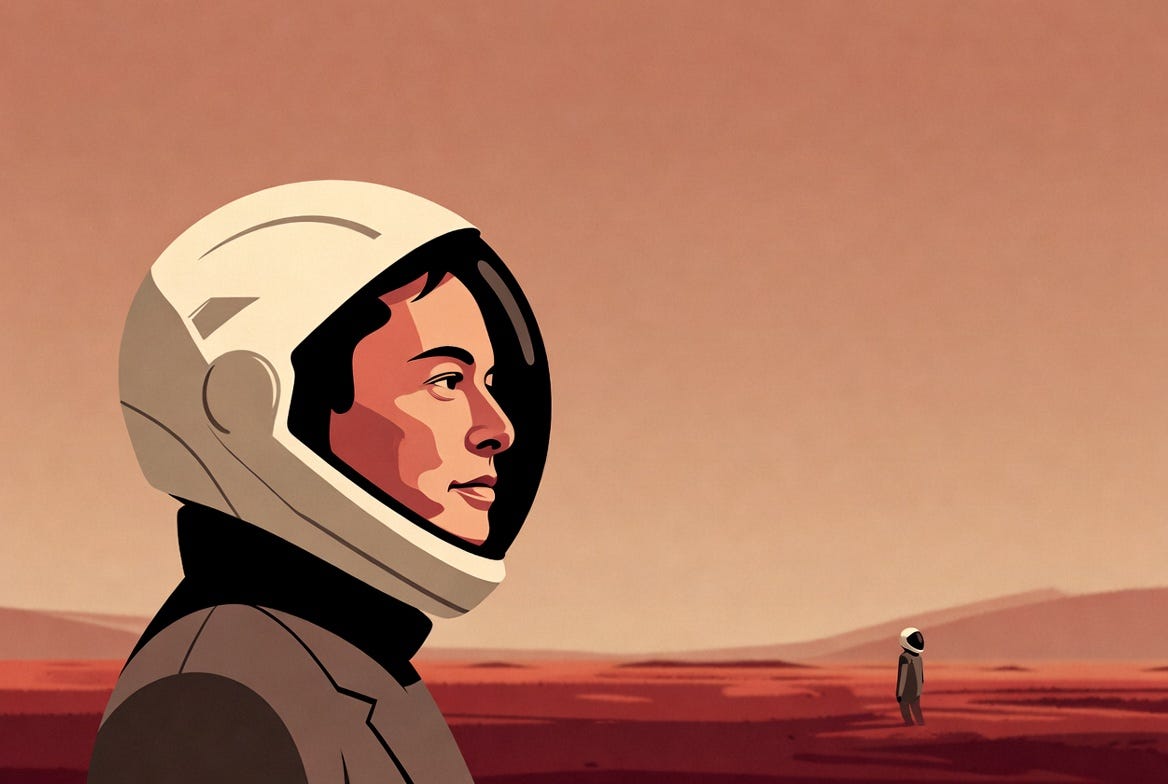
Where you plant your flag is a claim about what the future should look like. Musk’s claim is bigger than most, but it is not, at its root, any different from an old man planting a tree.
The oldest wish
Elon Musk often talks about his dream to die on Mars. It is a lofty goal, and if he could accomplish it, he deserves all the credit. But what would it actually mean for Musk to die on Mars?
What would that mean for humanity?
I imagine him at an old age, settling into his final years on a strange, new planet.
There would be a lot of adjusting. At this stage of colonization, you would be indoors with very limited space and social interaction. Your connection to nature would feel muted, like a wasteland. But you would also represent a future.
Living out your last years on a new planet, the work would look less like conquest and more like tending. You would nurture what’s fragile, plan for what you won’t see, and leave behind meaning for the people who come after you.
In Exodus, Moses wanders the desert with the Hebrews for forty years. Yet he suffers knowing he will not benefit from them. He will never cross into the promised land himself. Moses didn’t plant a tree, but he became one, providing shade for a generation he would never know. The pioneer and the patriarch are the same figure across every culture and every century. They move toward a goal they may not live to see.
Where the heart is buried
But why does someone like Musk also imagine dying in this newfound place? It is not enough to visit the planet. He wants to end his days there.
When David Livingstone died in Africa, his companions buried his heart under a mvula tree and sent his body to England with a note: you can have his body, but his heart belongs in Africa. He had asked for exactly this, because he knew, even in death, where he stood.
The heart aims for something and strives toward an idea. In the case of Mars, this might mean the expansion of human consciousness or the creation of a new era of exploration. And by being one of the first to be buried there, making your legacy about that idea, you cement yourself as the foundation of this new era. People return to the source — the person who inspired it — to be informed and guided by their vision. To end your legacy in a place is to give that place a beginning.
The last say
Where you plant your flag is your last say. It will outlast you and shape whoever comes next.
We work toward it for a lifetime, sometimes without knowing exactly what it is. But it matters that we follow that thread anyway, because at the end of it is something that outlives us. A presence that lingers and a foundation someone else gets to build on.
To be buried on Mars, then, is to send a message. It is the accomplishment of arriving at the first step one planned, and a signpost of everything one believed. You are no longer living, but you are there; part of this new thing, unconscious but physically present.
Like a tree planted in a yard you will never own, your shade falls on someone you will never meet.