


We don’t have momentous hurricanes every year in the same regions of Florida. Some years, the seasons are minimal, and no one really gets affected. In recent years, storms have targeted less common areas like the west coast of Florida. But if you live in one spot, let’s say Palm Beach or Broward, thinking of a truly consequential hurricane means going back several years.
For me, I have to go back 22 years.
In 2004, Hurricanes Frances and Jeanne hit us back-to-back in Palm Beach County and the rest of South Florida. They weren’t exactly monster storms; they were category 2 and 3. But they came closely together, and that damage compounded just a year later when Wilma hit along with several other storms. Out of all of them, Frances made the biggest impression.
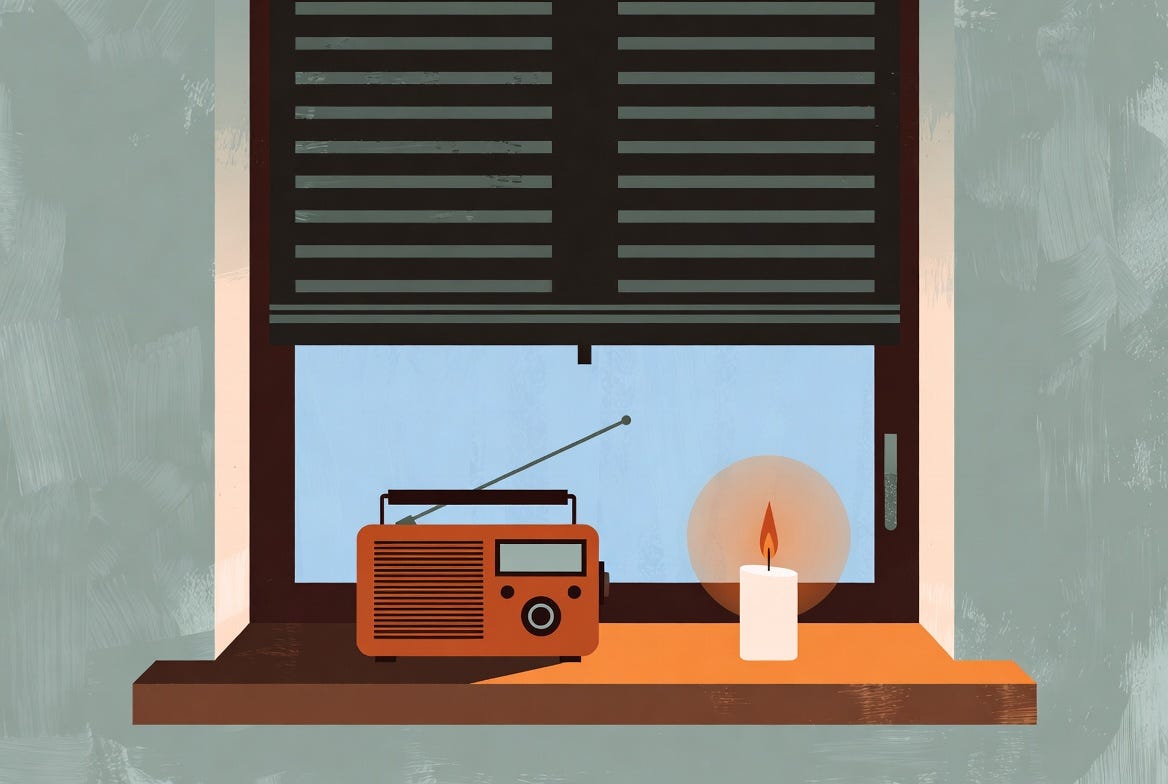
We lost electricity for two weeks, and the roof of my school caved in. At home, we had only games like Monopoly and Go Fish to keep us entertained, by candlelight and flashlight in a shuttered, screwed-tight house. To get a small amount of power when we needed it, we would run the car to power a fan or a little TV. But that was a temporary treat.
The one thing that kept us entertained and informed was the radio. Our emergency radio was a cheap model with an antenna, and it connected us to the weather station, talk shows, and music. Throughout the storm, we got updates on weather conditions, curfews, and police bans.
In one instance, an officer threatened my dad with jail while I sat in the car during an afternoon curfew; someone was already on the curb in handcuffs. My dad explained he was picking up his elderly in-laws, and, thankfully, the officer let us go.
The radio forced us to listen and focus on one thing. There were no other distractions when we used this analog technology.
Origins of radio
Long before radio, the experience of focused listening was the only kind available. Students in ancient Greece would listen to the likes of Homer recite his poems aloud. Though they could watch the poet, their minds were completely immersed in the stories of Achilles and Odysseus through hearing alone. All entertainment and information remained live, present, and singular.

Similarly, later lectures and music were always live events. If you wanted to hear a particular song, you went to a concert or to a restaurant where someone might sing it. There was no rewinding or selecting from a library. The experience required your presence and your attention.
Radio changed that. For the first time, you could receive sound without being in the same room as its source. Early radio required commitment; it was a large piece of furniture, plugged into a wall, and fixed in one place. I think of families in the 1940s gathered in the living room around a radio set, all of them sitting quietly in a shared agreement to listen together. The limitations of the medium were also its discipline: it decided what you heard, when you heard it, and where you had to be.
As modern societies became more individualistic and efficient, people wanted to take the radio with them. Portable radios made that possible, but the shift was costly. Listening became a solitary act, something you did while doing something else, and the communal dimension of the experience faded. Now, the radio was yours alone — but that wasn’t enough either.
The reincarnated radio
As radio has faded, its form has been reborn through podcasts and audiobooks. These are genuinely useful tools; I use them daily. But they are limitless, and that’s a problem.
Now I can multitask. I can listen to a podcast while doing two or three other things, drawing from an unlimited library of episodes. By the time I finish a few, I haven’t fully absorbed any of them. The surroundings shift constantly too: an audiobook on a walk, an audiobook while falling asleep, an audiobook on the way to a meetup. My attention is on the sidewalk or fading into a half-dream.
The radio had a schedule, yet podcasts have none. The radio had a fixed location, yet podcasts follow you everywhere. Progress, more access, and more flexibility dissolved what made the medium work: the constraint.
Listening the old way
This is why reading physical books is still so valuable. To receive the material, you have to fully engage your sight. There are no notifications, no easy way to multitask, no temptation to glance away without losing your place entirely. The medium enforces the attention it requires.
I discovered something similar recently. After a long stretch of organizing the garage, I lay down on my back, stared at the ceiling, and listened to a podcast. No phone in hand. Nothing else to do. The entire time, I was focused on what was being said, processing it fully, using only one sense. By restricting myself to hearing alone, I had to pay closer attention.
That’s the old way. And it’s still available.
The constraint doesn’t have to come from a storm or a power outage. It can be a choice: put the phone down, lie still, and listen. Use one sense on purpose. The technologies we have now are better than any emergency radio; the limitation is the one thing we have to supply ourselves.
We can listen the old way with new tools. And it’s in that kind of simplification, choosing boredom and focus over efficiency and multitasking, that we reconnect with something that has always been part of being human.
Read my latest piece on Business Insider → I thought traveling with toddlers was impossible. Now we live in Spain for 2 months at a time — and it’s cheaper than Disney.