


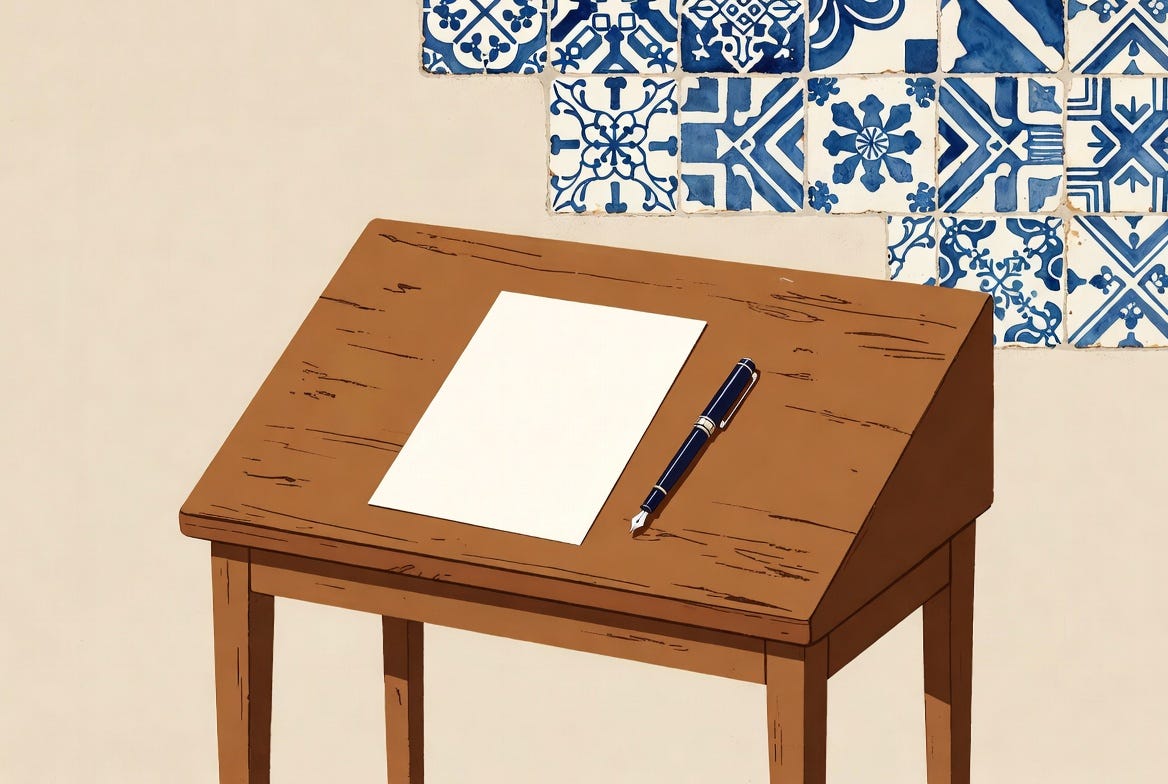
There is a tension that comes with a blank page. Writers have always known this feeling. Now, for the first time, they are being asked whether it is still worth wrestling with the art of writing on page one.
Today, AI can produce sentences. It can build paragraphs, arguments, even books. What it cannot produce is truth. It can only produce plausibility. And writers, from the beginning, have always been in the business of truth.
The oldest reason to write
Many great writers have written an essay titled Why I Write. George Orwell, perhaps the most famous, broke the act of writing down into four motives: sheer egoism, aesthetic enthusiasm, historical impulse, and political purpose. The proportions vary in every writer, but the drive underneath is the same: to see things as they truly are and set them down honestly.
Long before Orwell, John recorded a voice in Revelation instructing him to write, for these words are faithful and true. The command was not to write beautifully, or efficiently, or persuasively. It was to write truthfully. Hemingway, years later, put it in craft terms: write the truest sentence you know.
The imperative has not changed, but the pressure against it has.
So this question of why I write turns philosophical. It is no longer Why I Write but Why I Choose to Write. The difference is everything, and to understand it, I keep coming back to tiles.
The value of imperfection
I am a fan of Spanish and Portuguese tiles. I enjoy seeing vibrant blue designs all over tiles on streets and homes. They are beautiful because someone took the time to craft them. They are inefficient and not technically necessary; a machine can do that. But machine-produced tiles look the same. There aren’t slight variations per tile, and they look dull. The beauty lives in imperfections, originality, and the heart that goes into the art.
This is what Orwell called aesthetic enthusiasm: the pure pleasure in arranging things just right. But “just right,” in the case of modern art and writing, doesn’t mean perfect. It means true to the hand that made it.
These tiles are rare and sought after. I am jealous of those who live in cities where craftsmen make them. It is very difficult for me to find local versions in South Florida. A store might carry them, but craftsmen did not make them by hand. If I want the real thing, I must import them, and the markup makes that impractical. Until then, they remind me that some things hold their value precisely because they cannot be scaled.
The writer’s situation is the same. Great writing reflects our unique perspectives, as original and rare as a fingerprint.
The writer who can express a fresh perspective clearly, and connect with a reader, will outlast AI. Not because machines are inferior, but because the value was never in efficiency or perfection. It lives in the fingerprint: the rugged, raw, organic wonder that introduces itself to the world for the very first time. There is nothing special about efficient writing. There is, however, something special about a true sentence.
The garlic problem
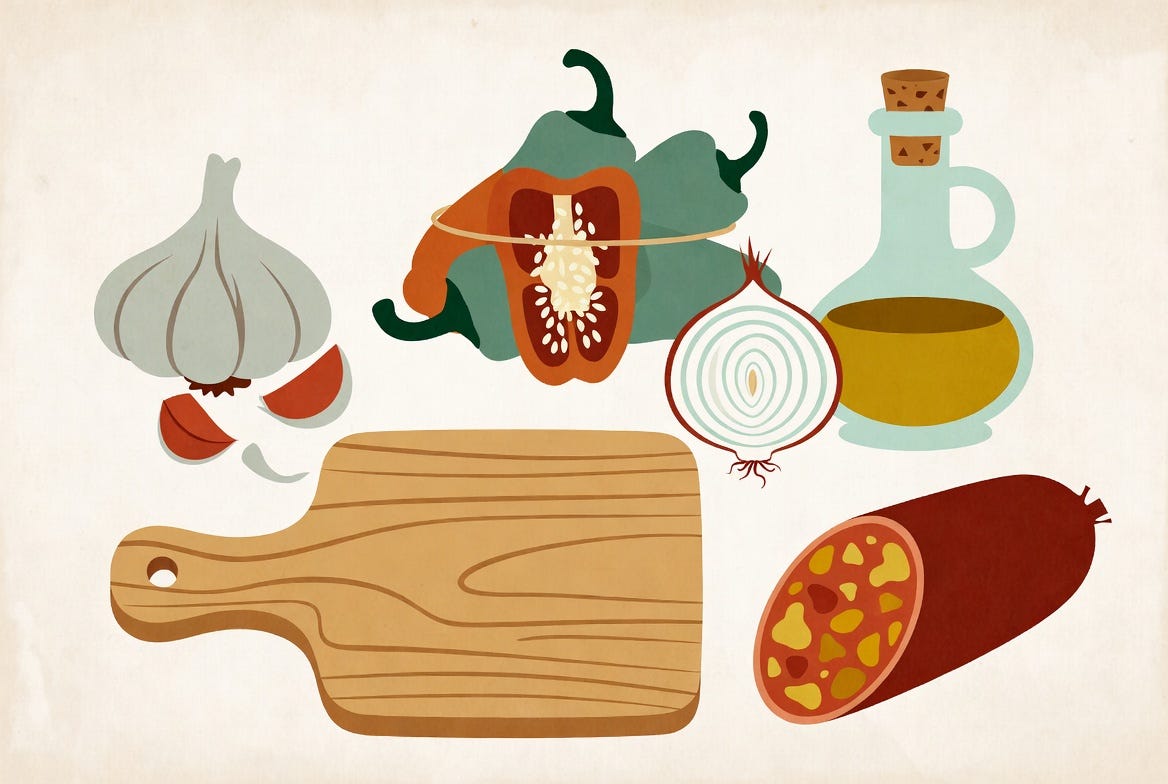
I find that asking AI to produce something, even with unique ideas and outlines, will still saturate the piece with sameness. My grandmother’s kitchen taught me why. In my culture, our most prevalent spice is garlic. My grandmother would start each dish with garlic, sweet peppers, onion, olive oil, and a slice of Spanish chorizo. This sofrito formed the base of every dish and gave it its familiar and profound tastes — and it was the perfect balance.
But let’s say someone loved garlic so much that they added an entire head to every dish, no matter what they were cooking. It would not matter if they were cooking meat, chicken, or squid; everything would taste like garlic, to the point that these dishes, even with pungent tastes, may taste entirely the same.
AI is the overextended garlic: it saturates everything it touches with the same flavor, the same rhythm, the same angles, until the dish no longer tastes like anything in particular.
An outline and big-picture idea can go through AI, but it will fill in the gaps with overused ideas, examples, and angles. Even during revision, if you correct something or change it, AI might revert to its original clunky phrasing and staccato sentences; in essence, you’re fighting with the tool to keep your voice. Prompts help, but the dance, the tango, never goes away.
Writing as discovery
But truth is not only found on the page. It is also found in the act of reaching for it. Joan Didion understood this perhaps better than anyone. In her own essay Why I Write, she said she wrote entirely to find out what she was thinking, what she was looking at, what she saw and what it meant.
Writing, for Didion, was discovery, not output. In my own life, I often find that if I feel overwhelmed, it is because I have not written. When I write my thoughts, concerns, and ideas on paper, I express myself and feel much better. Writing externalizes energy that builds up within the mind. If you cannot immediately act on your thoughts, you store only passive energy, and there is only so much you can hold before you feel overwhelmed.
When you interact with AI, you lose this exercise. The writer instead holds conversations with AI and falls into thought loops that feed paranoias and realities that may not even exist. I noticed this in my own life: the more I leaned on AI during the creative process, the harder it became to hold attention, to sit with a problem, and to think a thought all the way through. So I made a change. I now limit AI deliberately, and I only bring it in after the creative work is done. The research supports this instinct. Studies already show cognitive decline in basic tasks when people use AI too much, and mental health concerns are rising among heavy users.
Writing is communication, and we need the ability to communicate with ourselves and with others. If we replace that communication with total reliance on AI, we don’t just lose a skill. We lose the instrument through which we find out what is true.
The struggle is the source
Originality and communication matter. But art cannot be delegated. The writer can use AI to aid in this art, but they must still be the captain. Otherwise, by letting AI lead, they become passive participants in their own work. The benefits of art, which are expression, beauty, and appreciation, no longer belong to the human when they do not sit in the pilot’s chair.
Great art is often different, shocking, or the result of a real struggle. In his essay Why I Write, Orwell described writing a book as “a horrible, exhausting struggle, like a long bout with some painful illness,” driven by a demon one can neither resist nor understand. That demon belongs to the writer alone. No one can summon it on their behalf, and no tool can wrestle with it in their place. I’ve heard it said that if you feel frustrated about something, or you have something you can’t keep to yourself, then you’re ready to write your novel. This is very true, and it is why art is intimate. The demon is not a problem to be solved. It is the source.
As time passes, we will see more AI art where the human does very little. Many people will enjoy it. But it will not deposit into a greater conversation, not until an artist has something true to say. Plausibility fades. Truth accumulates.
Only you can write it
This is why we still write. If it were about output, writers would have always hired a team. They never did. Because writing is not a service you outsource to yourself, let alone to a machine. It is the thing itself.
We should write because we breathe; because we love; because we continue to desire connection and expression in this world. And because somewhere between Orwell’s demon, Didion’s discovery, and John’s faithful and true, there is a sentence only you can write.