


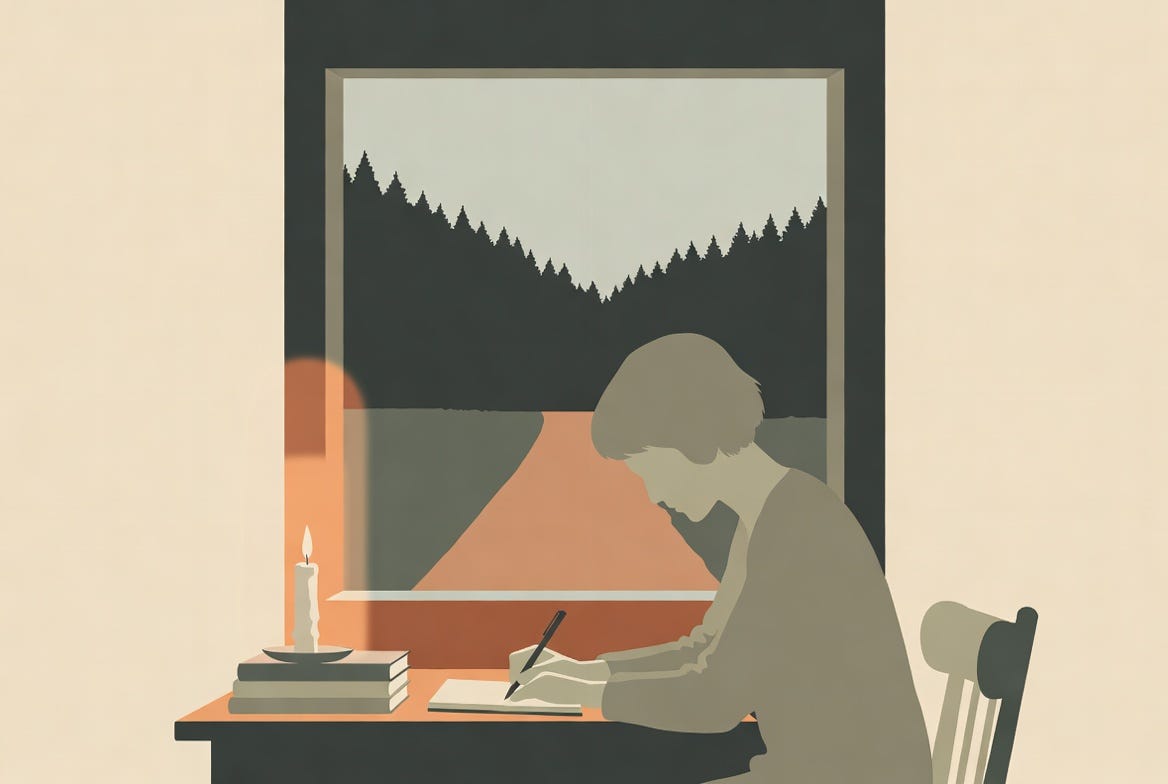
If you’re struggling with something, you have a story in you. It’s no coincidence that Chinua Achebe compared the act of writing to the same thing: “Writing is like wrestling; you are wrestling with ideas and with the story.” Not everyone is a fiction writer, but everyone does have a story to tell, whether that’s a novel or the shorter version, a novella.
These works do not have to become famous to be successful, and that’s what’s so liberating. These works represent a moment in your life, a piece of your consciousness, and how you felt at the time, through fiction.
One could write a memoir or something non-fiction, and they should, but the creative story allows for expression and a visual journey to overcome what’s happening in your life. And this approach is especially effective if you are not ready to write a true account because you cannot articulate it.
If you are facing a sickness, for example, you can write about someone going through something similar. Since you are not writing about yourself directly, you are experiencing the third-person effect where you begin to see things as an outsider with all the challenges, undiscovered perspectives, and silver linings you didn’t think of yourself. No matter what the result of your current situation is, you have an artifact that represents your experience and one you can share with others.
Along with telling a story to process events and share them, the act of writing a story also helps you work out your own problems. C.S. Lewis wrote A Grief Observed after losing his wife Joy to cancer; these were raw notebook entries he never expected anyone to read.
These experiences are also cathartic. You feel as a writer, and reader, that you aren’t truly alone, because now there is a character that is going through it too. Part of you wants to help your character, but you must let the plot move forward. In the end, there’s some type of resolution, and you find that maybe, no matter what happens, it’s not as bad as you’ve ruminated it to be.
For example, when one reads Dante’s Divine Comedy during an uncertain time in their life, there’s a real catharsis in reading about the dark woods and ending up midway in your life without knowing what to do next. The opening lines say it beautifully: In the midway of this our mortal life, I found me in a gloomy wood, astray. The line is a reminder that even the greatest journeys begin in confusion.
What’s less discussed is what Dante was living through when he wrote it. He had been exiled from Florence, stripped of his property, and sentenced to death if he ever returned. The Divine Comedy, then, becomes an artifact of a man working through political ruin, displacement, and a life turned upside down.
So what is your dark wood? A diagnosis, a marriage fraying at the edges, or a career that might be fading away. While existing stories are helpful, they are not from you. And it’s in this opportunity that you can write a story that represents your experience in the world.
Many writers are remembered for their later works, almost as if they reached a new stage in their lives and could finally articulate what they feel and what they want to save. Writers like Cormac McCarthy and his work Blood Meridian, and Philip K. Dick and his work Ubik came later on. But in both cases, there was a birth, something new that inspired this new phase of the writer.
Even on the other end, it’s often those first few stories that stick long after the author’s life. Ernest Hemingway is often remembered by The Sun Also Rises and A Farewell to Arms; less so for Across the River and Into the Trees or Islands in the Stream. In each case, the most enduring work was a moment in their lives that demanded to be written.
I’m writing a novella I may never finish or see published, but the act of writing it has helped me work through personal challenges in a way I couldn’t articulate through journaling or other exercises.
Not everyone can write elegantly or grandiosely enough to write a captivating novel or short fiction. But great stories often trump clean and pretty writing. And once you’ve written for yourself first, the novel has already done its job. It helped you work through your challenges, see things from a different perspective, and express yourself instead of ruminating on the issue. Then, just maybe, one other person may find it useful. And that in itself is worth it all.
it’s just a good exercise, I hear you, even if it’s never published or distributed, we all have a curiosity and imagination that should be expressed