


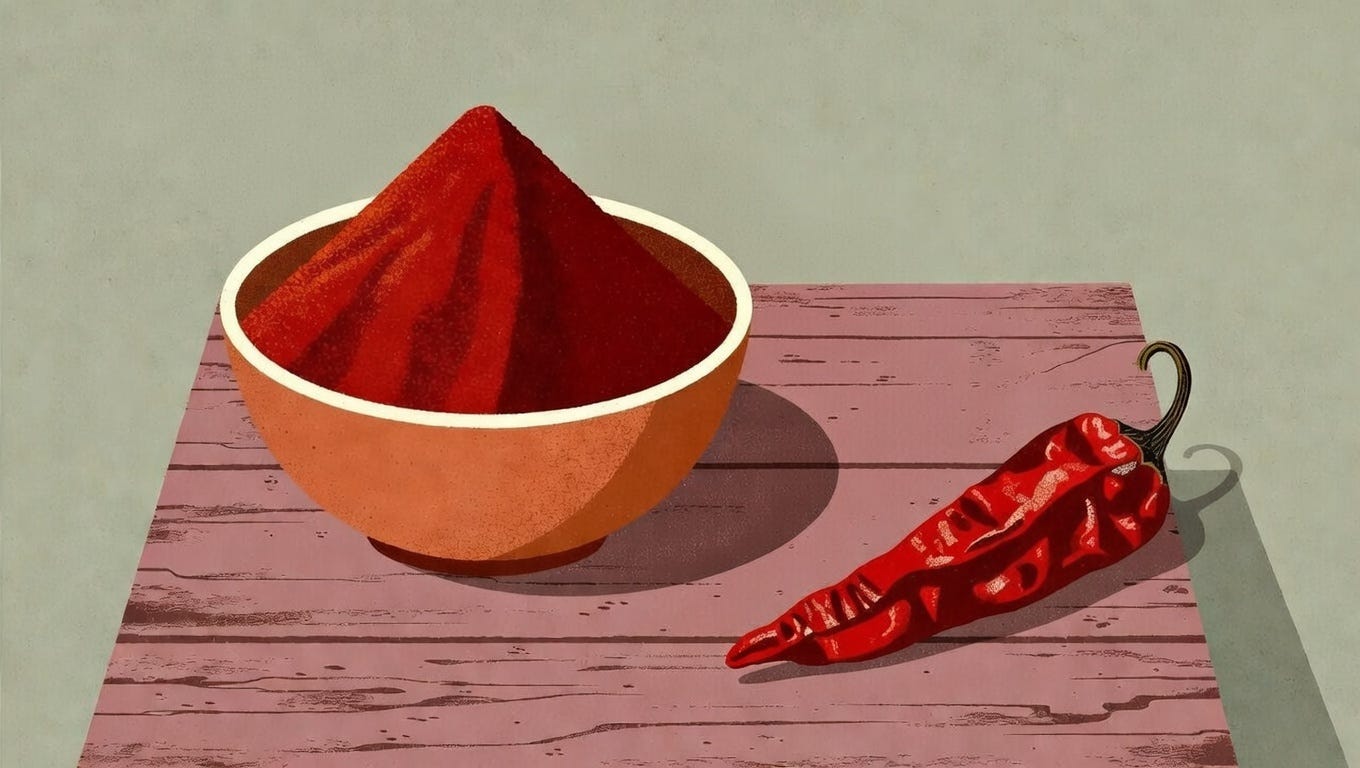
Growing up in the U.S., I didn’t appreciate pimentón dulce, or paprika. Part of the reason is that it was so bland. Though things have improved over the years, the quality was very poor at that time; and it was why I, along with so many others, thought it was mainly a natural coloring agent. It’s strange how a bad version of something can make you distrust the thing itself.
This bland, or subtle, powdery flavor was an optional ingredient. But in spite of that reality, I had always loved paprika. I just didn’t know it.
It was present in almost every dish I ate. My grandmother would make her sofritos with Spanish chorizo, embedded with rich pimentón dulce. The redness from the spice, the smokiness, solidified taste and memory in my childhood and made every dish she cooked delicious.
Over time, I had less and less of it. Then I wrote off the spice entirely; whenever I’d try it, it wouldn’t taste like anything. It wasn’t until I traveled that I began to taste the real thing for what it was. The richness, boldness, and smokiness of paprika dominated dishes. With a tiny pinch, you could change the flavor into something new and memorable.
Paprika is a unifying spice—you find it throughout global cuisines.
The bell pepper originated in Central Mexico, where indigenous peoples cultivated it for thousands of years before Spanish explorers brought it to Europe; pepper seeds are documented as arriving in Spain as early as 1493, following Columbus’s second voyage.
From Spain and Portugal, it spread across the continent, eventually reaching Hungary through Ottoman influence and the Balkans. There, it was named paprika, while the Spanish variation, pimentón dulce, evolved along its own path.
The spice traveled further still: it’s a foundational ingredient in Arabic cuisine, appearing in baharat, the aromatic spice blend used across the Middle East in dishes like shawarma and kofta, and even hummus carries it as a finishing touch. In Asia, it found its place too; paprika is a key ingredient in Indian tandoori spice blends, lending the dish its characteristic deep red color.
Since my resurgence of appreciation over the last several years, I’ve found the right places in the U.S. to get the best paprika I can; I have a drawer of pimentón dulce I bring back from Spain; and I include it, as a subtle addition or as the star of the dish, in almost every meal I make.
These experiences remind me of something about perception.
Often, we try something for the first time and don’t like it. But the ingredient or dish isn’t always the best representative of itself; you find out much later that it was simply poorly made.
Tinned fish is like this too. In the U.S., many people won’t touch canned sardines or anchovies. But when I consider the cans they would’ve picked up for the first time, I probably wouldn’t have either.
This is why, in every awkward experience with food, it’s critical to ask whether what you’re trying is the best representation. Only people who’ve grown up with a dish can tell you. It’s worth having those conversations, in person or in online communities.
“Often, we try something for the first time and don’t like it. But the ingredient or dish isn’t always the best representative of itself; you find out much later that it was simply poorly made.”
Though, more than giving things a second chance or vetting your experience, this points to something more crucial: pride in quality and care for ingredients.
As things grow more expensive with inflation, and more scarce, it’s difficult for restaurants and stores to offer the best ingredients. While chefs and business owners value quality and respect for food, they can only do so much if consumers have a ceiling on price. But not everything needs to be expensive.
Perhaps dishes could be simpler, or smaller in quantity. People don’t always want to stuff themselves; they want an experience they’ll remember. And I think things are moving in this direction; we can thank nutrition-conscious consumers for that.
People value quality when it comes to health, and this could be an avenue for richer experiences. It has already permeated the fast food industry, with places like Chipotle, known for its fresh ingredients and transparent sourcing, and Panda Express, which has made visible commitments to reduce artificial additives and offer lower-calorie options. Perhaps this will eventually translate to a broader demand for quality ingredients.
But to reach a consensus on valuing quality over cheapness and convenience, society has to transition from surface-level health-conscious choices to seeking genuine nutritional density. A 2004 study by researchers at the University of Texas, comparing USDA nutritional data from 1950 to 1999 across 43 garden crops, found reliable declines in protein, calcium, iron, and vitamin C over that half century; the result, researchers concluded, of breeding crops for yield rather than nutrition.
A bell pepper grown today is not quite the same bell pepper your grandmother bought. To compensate, a consumer would have to eat more of it and spend more money; when in fact a single, fresher pepper from a local farm would likely deliver more nutrition for the price.
Local purchasing, through sustainable farming practices, can help close this gap. But in industrialized countries, it’s difficult to find the same variety, options, and healthy market competition that would make this possible.
“[…] to transition from surface-level health-conscious choices to seeking genuine nutritional density.”
There is, of course, a counterargument. Local and artisanal food is not equally available to everyone; and for many families, the industrial grocery store, with its imperfect peppers and frozen bread, is not a compromise but a lifeline.
The romanticism of farmer’s markets and home-ground spices isn’t accessible to everyone based on time, location, and income. Critics of the local food movement point out that scaling sustainable farming to feed cities is not yet a solved problem; that supply chains, however flawed, have also made calories accessible in ways that weren’t possible a generation ago.
These are fair points. But I think they argue for better distribution of access, not for accepting a lower standard as the ceiling. The neighbor selling homemade bread isn’t trying to disrupt agriculture; she’s filling a hole for a solution that does not exist. And perhaps that’s where change has always started: not in policy, but in someone deciding to do the thing themselves.
So what is a person to do? Start from scratch. More and more, I see neighbors making their own bread with flour, water, and yeast, because out of the seven stores to buy food within a three-mile radius of my home, only one sells bread like that, and it’s frozen. So neighbors make their own and sell it to each other.
“[…] these experiences, and the pursuit of quality ingredients, bring back the case for reality and autonomy.”
I make my own paprika. Though not as smoky as I’d like, it’s delicious and far more potent than anything I can buy here. I char the peppers on the grill, dry them, and blend them into a powder.
Others keep their own chickens for eggs, or get them from friends. My family knows a few friends in the rural parts of Okeechobee, and that has been wonderful; we enjoy the extra nutrition and the deep yellow yolks.
These small changes eventually influence the economy, and companies take notice. They may find ways to game the system, using language that makes ingredients technically accurate but far from what you’d imagine, but nonetheless, there is a movement, and it’s hopefully heading in the right direction.
In all, these experiences, and the pursuit of quality ingredients, bring back the case for reality and autonomy.
There will always be things that restrict us. And perhaps there’s only so much we can do. But when we find our own answer to the challenge, our own way of mending that hole, things become beautiful again, and they inspire others too.
I used to make my own paprika and it was superb with no additives.