


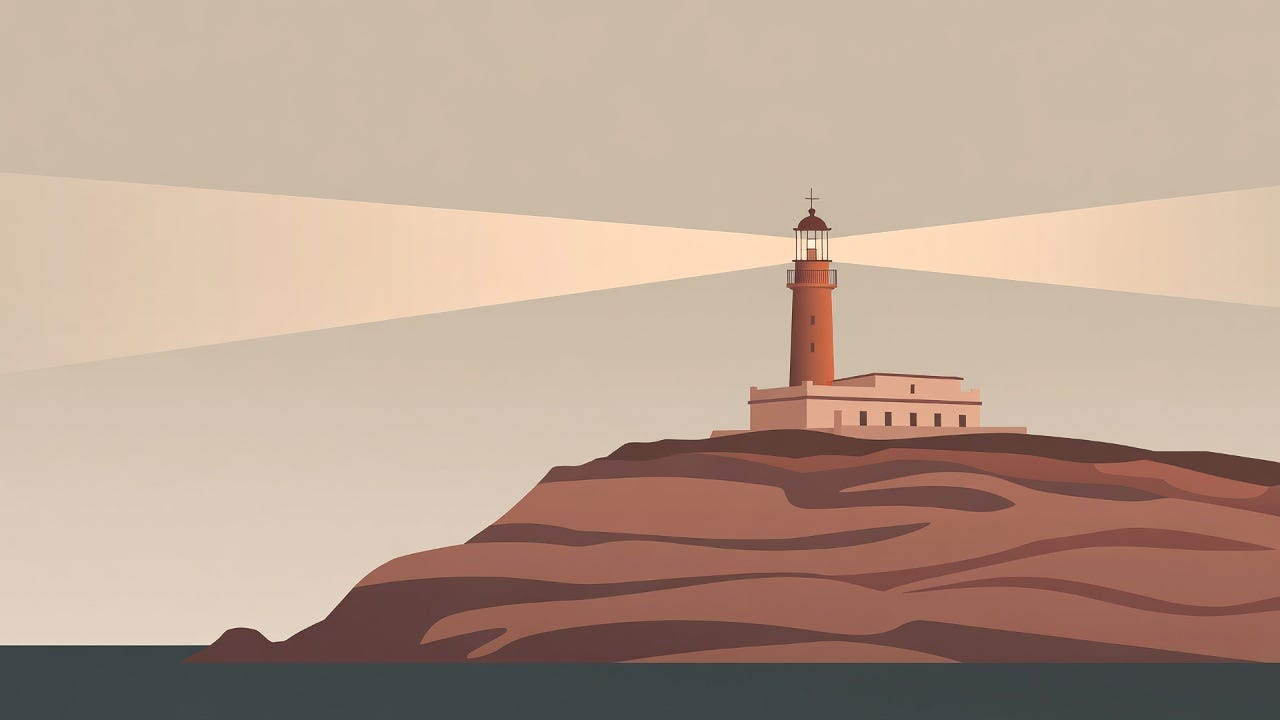
Before GPS and radio triangulation, before any of the navigation technology we now take for granted, sailors in fog relied on a single thing to reach the shore: a light.
The lighthouse keeper’s job was not to be brilliant. It was not to broadcast. It was to tend the light and keep it burning consistently; to make it reliable enough that a ship miles out in the dark could find its bearing. The keeper, however, wasn’t the destination, but the orientation. There’s a difference.
I think about that distinction a lot when I look at what we call “content” today.
There’s more of it than ever. More posts, more newsletters, more podcasts, and more takes; a permanent, scrolling fog of borrowed words and ideas. A concept surfaces somewhere, gets picked up and rephrased and redistributed until it’s been repeated so many times no one can remember where it came from. This is noise. And it multiplies until the original signal disappears.
The internet made publishing frictionless, and that’s genuinely good. But it also made borrowing frictionless. When you can build an entire piece of content from three tabs, a summary tool, and a template, you don’t need to think — you need to produce. And producing without thinking is how the fog gets thicker.
I know this because I contributed to it. In my early days of writing, I was focused on volume; showing up and saying things. I told myself consistency was the point. And in some narrow sense, it was. But I wasn’t diving into anything. I was summarizing things other people had already dived into. I was holding up a mirror to someone else’s light; not my signal, but a reflection.
“The internet made publishing frictionless, and that’s genuinely good. But it also made borrowing frictionless.”
There’s an old Aristotelian distinction between knowing a thing and knowing the cause of a thing. You can know that aspirin relieves headaches without knowing why. Most of what passes for insight online is that first kind of knowing (the what without the why). Aristotle would have called it experience, not wisdom.
Original thinking begins when you refuse that shortcut. When you go back to the source instead of the summary. When you read the actual study, the actual primary text, the actual history, because you want to understand something well enough to have an opinion about it that belongs to you.
This is harder than it sounds. It’s slower. It often leads nowhere useful for months. But there’s a particular kind of confidence that comes from knowing you’ve actually read the room for yourself. You start to notice gaps in what everyone else is saying. You start to ask questions that haven’t been asked. And the questions, it turns out, are where the original thinking lives.
Curiosity is a practice. You can get better at it, and the first step is treating the obvious sources as the beginning of the research, not the end of it.
The ideas worth keeping are usually the ones you almost didn’t pursue because they feel too niche or strange, too far from what people seem to want. But that strangeness is often the signal. It means you’ve gone somewhere few people have bothered to go.
When I find one of those ideas, I ask myself a few things. Would I spend time with this even if no one read it? Is there something missing in how it’s been explained, some gap in the logic I could actually fill? Does my particular background give me an angle on this that someone else wouldn’t have?
That last question matters more than it sounds. The goal isn’t to write from identity as a credential. It’s that your experience is irreducibly yours, and that specificity — when it’s honest — is what makes writing feel like it was written by a human being and not assembled from parts.
“Curiosity is a practice. You can get better at it, and the first step is treating the obvious sources as the beginning of the research, not the end of it.”
A lighthouse is useful because it’s in a particular place and there’s specificity.
Once you’ve found an idea worth developing, the worst thing you can do is present it fully-formed. Tear it open first and push on its assumptions. Find out what it’s taking for granted. Ask why the idea exists.
This is where the real work is: in the dismantling; sitting with an idea long enough to understand what’s holding it together and whether it actually deserves to hold together.
Then, when you rebuild it, you rebuild it in your own voice, for your own reader, with your own honest assessment of where it’s strong and where it still has questions it can’t answer.
That honesty is what keeps writing from becoming noise. While noise is confident, the signal admits what it doesn’t know and drives curiosity.
I don’t think the goal is to be original for its own sake. The goal is to be useful — to offer someone a way of seeing something they hadn’t considered, a question they hadn’t asked themselves, a bit of orientation in a fog they’re already tired of navigating.
The lighthouse keeper didn’t tend the light to be seen. They tended it so others could find their way.
Maybe that’s the right frame. Not: how do I stand out? But: what do I actually have to offer, and am I willing to do the slow, unglamorous work of finding out what that is?
I’m still working on that question. I suspect I will be for a while.