



Right out of high school, I was managing a team of employees at the front counter of a fast-food restaurant. It was my job through college, and I enjoyed the many lessons I learned there, including helping with grand openings. In those early days, everything felt like a great storm—especially the day we ran out of buns.
What do you do when you don’t have a main ingredient?
I learned the answer quickly, while imagining myself trying to explain to customers why two-thirds of the menu was suddenly unavailable. Thankfully, I wasn’t the only manager on shift that day.
Someone a couple of decades older than me happened to be there for part of it. He helped me work through the situation by calling other stores in our franchise to ask for extra buns. When those stores said they didn’t have any—and when I normally would have hit a dead end—he suggested going to a warehouse store like Costco or Sam’s Club to buy emergency buns.
The buns were slightly different, and corporate wouldn’t have liked the idea, but it solved the problem. We could only react to the immediate emergency, not the deeper inventory issue, which we had no control over. We let customers know ahead of time that the buns were different, and they were fine with it.
What stayed with me wasn’t the workaround itself, but how it emerged. While I was busy bracing for impact, someone else had paused long enough to orient himself within the problem.
Through that experience, and many others, I began to notice how often the urge to look busy replaces the harder work of stepping back; of observing the problem, identifying the bottleneck, and resisting the comfort of motion. Stepping back, and resisting gut reactions, often allows clearer thinking and better decisions.
History offers harsher examples of what happens when that pause never comes.
Betting on the wrong ideas
The Wager: A Tale of Shipwreck, Mutiny, and Murder by David Grann recounts the 1740 wreck of the British warship HMS Wager off the coast of Patagonia and the chaos that followed. Stranded sailors fractured into rival groups, each struggling to survive under brutal conditions. When some survivors eventually returned to England, they offered sharply conflicting accounts of what had happened.
One group framed their actions as discipline and heroism; the other described mutiny, cruelty, and murder. The resulting court-martial forced the Navy to decide not only who had broken the rules, but whose version of the truth would be believed.
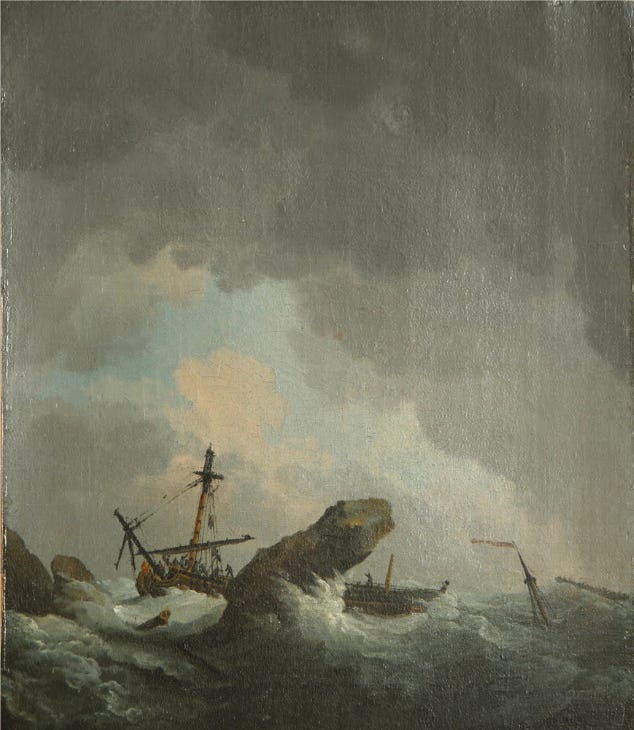
At its core, the book examines how people behave under extreme pressure, how authority erodes, and how truth itself becomes unstable when survival is at stake.
David Cheap did not spend decades growing into the role of captain of the HMS Wager. He was promoted shortly before the voyage, elevated by commission rather than long experience in independent command. When the Wager wrecked and order collapsed, Cheap clung to naval hierarchy as the last structure he knew. His authority was real, but new and untested, and under brutal survival conditions, it proved brittle. What had made him captain on paper became, in extremis, a source of isolation, conflict, and ultimately mutiny.
Cheap had potential; it’s why he was promoted. But he focused more on making a name for himself than on accepting short-term retreats for long-term success. When the ship faced treacherous waters and worsening weather, Cheap sailed onward against the wishes of his advisors, hoping momentum itself would carry them through. Instead, he shipwrecked his crew, and their journey ended in sickness, death, turmoil, and scandal.
Had the captain listened to his advisors and sought refuge elsewhere to wait out the conditions, he might have become a successful captain through that decision alone, marking his name in naval history as a hero. This tension—between stubborn resolve and prudent restraint—appeared repeatedly among both his enemies and his supporters during the stranded journey.
This arrogance cost Cheap much of his legacy. But it also leaves us with a lesson that is less comfortable than it appears: progress does not always come from pushing forward. Sometimes it comes from stopping, assessing, and absorbing wisdom—even when time feels scarce.
Taking a step back
The best advice I received in my early days of management was simple: stop.
When everything seemed chaotic, with long lines at the register, my instinct was to jump on a register to help. It felt useful and visible. But that wasn’t the bottleneck. The real issue was often a delay in the kitchen for a specific food item, which then rippled outward into longer lines up front and in the drive-thru.
An experienced manager once told me not to act right away, but to step back and watch what was happening for a few minutes. By taking that time—even when it felt like precious time lost—I could solve the problem more accurately and more quickly than if I had acted blindly.
This tension is a contest between reaction and judgment. We can react immediately, as a busy or anxious person might, or we can slow down and absorb enough information to decide well. Often, it’s only by stepping back that we uncover not just the real problem, but the real purpose.
The Gospel of Luke offers a familiar illustration. Jesus is surrounded by his followers in Martha’s home. Mary, her sister, listens intently to his teachings. Martha, meanwhile, is stressed about preparing the food. Her concerns are valid—but she misses the moment’s purpose. There would always be time later for meals and order.
In this instance, teaching, wisdom, and presence mattered more. That’s why, when Martha says, “Lord, don’t you care that my sister has left me to do the work by myself? Tell her to help me,” Jesus replies, “Martha, Martha, you are worried and upset about many things, but few things are needed—or indeed only one. Mary has chosen what is better, and it will not be taken away from her.”
Mary’s stillness is not a rejection of action, but a reminder that attention matters—and that motion without awareness often mistakes urgency for purpose.
Shaping a mental mode for stepping back
Over time, I began to notice a pattern in the moments when restraint actually helped. It wasn’t a formula, and it wasn’t something I followed consistently, but the same posture seemed to repeat itself whenever judgment improved.
I first encountered a version of this idea through Brendan Burchard’s High Performance Habits, where he describes how high performers intentionally choose the emotional states they bring into demanding situations. But I’ve also seen it expressed in simpler, quieter ways.
There’s a story that circulated online about a hardworking father in the trades who would sit in his car for a few minutes before entering his home, sometimes touching the tree in his front yard, leaving his work frustrations outside so he could show up fully for his family. The ritual wasn’t about productivity or discipline. It was about transition and refusing to carry one context unexamined into another.
When restraint worked, it usually began with a period of watching and listening. In moments of pressure, the instinct is to react quickly, driven by anxiety or fear. But when I resisted that pull and focused instead on absorbing what was actually happening—who was involved, where tension was accumulating, what signals were being missed—the situation often revealed more than it did under immediate action.
After that pause, certain details tended to stand out. Some problems announced themselves loudly, while others quietly shaped everything downstream. Over time, I learned that identifying the real source of friction mattered more than addressing surface symptoms.
A business professor once described this as “finding the artery first.” When an artery is damaged, the entire system suffers. You can treat symptoms, but unless the core issue is addressed, the damage continues. In business, that artery is often cash flow. Without it, fixing smaller issues becomes a fruitless exercise.
Context, I found, was what ultimately determined whether restraint helped or hurt. A family member of mine owns a commercial holiday lighting business and once secured a major contract with a city planning for a Christmas event. When a key supplier delivered late, the city leaders were disappointed but understanding. My relative could have blamed the supplier and installed only what was available. Instead, he recognized the broader context. The event mattered deeply to the city, and visible gaps would affect the relationship regardless of fault. He used his own inventory to complete the display as planned, then added the delayed items when they arrived.
The result was more than a satisfied client. He demonstrated reliability under pressure (this solidifies long-term relationships). Awareness, not urgency, guided the decision.
A quieter version of this tension appears in John Williams’s Stoner. The profession, William Stoner, is right to challenge a student he believes should not advance. Still, he presses the issue so directly that it becomes a defining battle, costing him allies and shaping the rest of his career. With greater awareness, he might have chosen to lose that fight and preserve his energy for the work and life he ultimately cared about. In some ways, he may have forgotten the advice he once received from his mentor:
“You must remember what you are and what you have chosen to become, and the significance of what you are doing.”
For me, even when clarity emerged, there was still the temptation to drift toward the what ifs—to imagine cascading failures, hypothetical outcomes, and consequences that hadn’t yet arrived. That habit often created paralysis rather than progress. What restored movement was a quieter shift toward the what cans: what could actually be done now, in this moment, with the information at hand.
Not long ago, when I experienced several challenges at once, they felt impossible to solve together. My father reminded me to focus on one thing at a time. That reminder didn’t resolve everything, but it pulled me out of speculation and back into action. By staying with the what cans, the rest gradually followed.
Developing routine checks
This habit is fragile. Under pressure, it’s easy to revert to old patterns. The instinct to act, to prove usefulness, to signal control, is powerful. With time and repetition, the pause becomes easier to access, but the early stages are critical.
What helps me maintain perspective is building visible, tangible habits. When I feel overwhelmed by outcomes, I return to my task list. Fixating on the end result without addressing the steps gets me nowhere. Progress, even incremental, restores confidence.
I also try to ask about purpose. Before important decisions, I ask why I’m here and what I actually want long term. What will matter five years from now? These questions pull me out of survival mode and back into perspective.
Ultimately, mental health is the foundation for stepping back and assessing clearly. That foundation requires care: limiting dopamine-driven distractions, setting no-digital time blocks, practicing meditation or prayer, staying socially connected, exercising, and spending time outdoors.
I still don’t always pause before reacting. But I’ve learned that when judgment fails, it’s rarely because I lacked options. More often, it’s because I moved before I understood where I was.