


I didn’t start as a big reader growing up. I read an average amount of books and content, mainly the things I was required to read in school. I was interested in certain works and read them for fun, but I really didn’t develop that appetite until my senior year of high school, and then voraciously in college.
Over time, my love for reading grew bigger than my ability to consume it.
I remember walking into libraries excited to find something new, but also feeling a bit melancholy knowing I won’t live long enough to read everything of value. I still think about walking into a library in West Palm Beach in high school and feeling the shelves close in on me with the weight of everything I’d never get to read because of the laws of time.
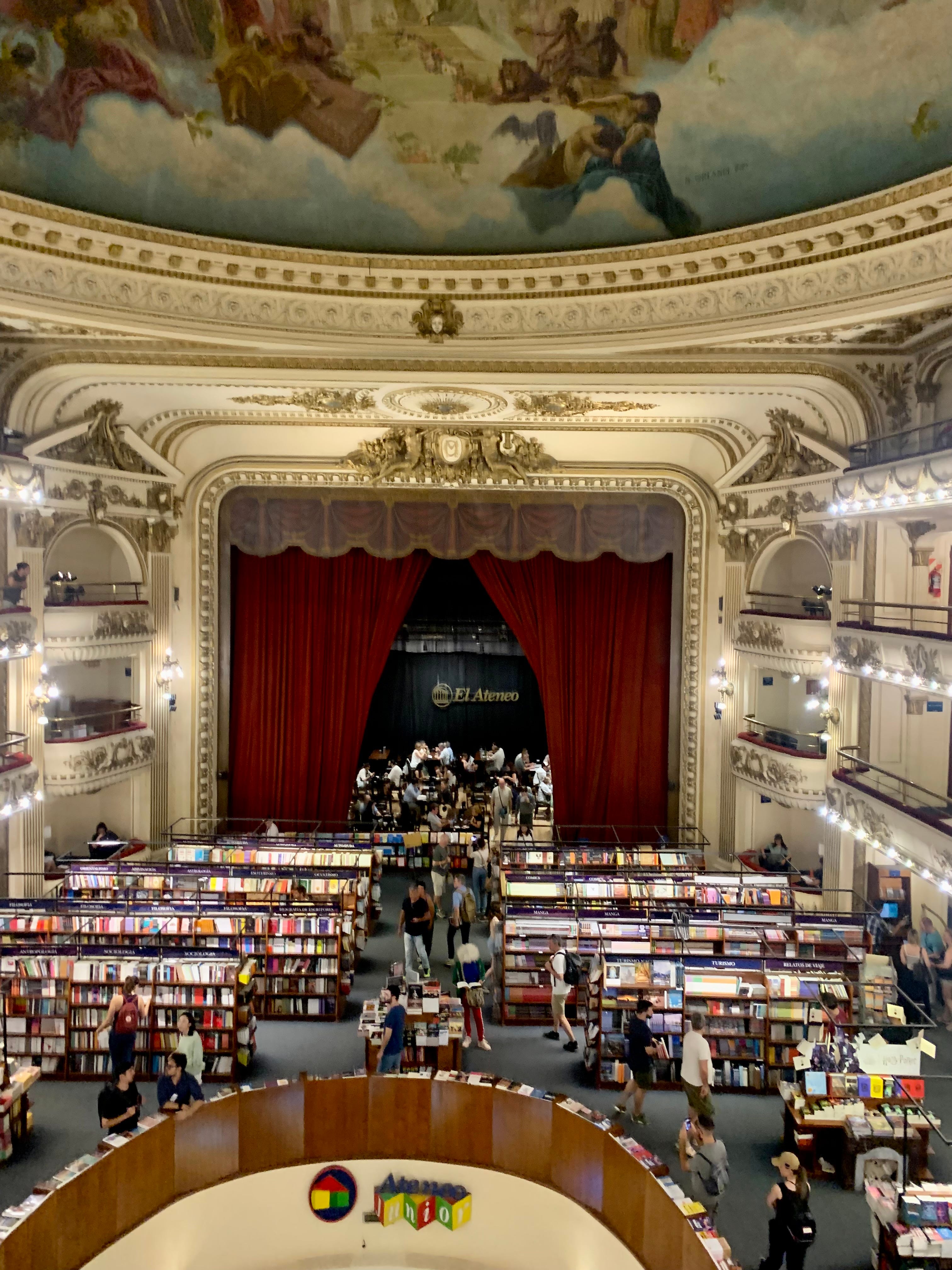
Years later, standing inside El Ateneo Grand Splendid in Buenos Aires1, a converted theater where the balconies are still intact and the stage is a café, I felt it again. All that beauty. All that impossibility.
Over time, I learned to read by interest rather than relying on top reading lists. This made reading much more approachable. If I had an interest in early American history, for example, I could read the canon of foundational works and feel competent enough to discuss or even teach it — and then dig further down the rabbit holes if my interest continued to grow.
The appetite that keeps expanding
That appetite, however, kept expanding. I found myself wanting to read everything that came my way — the news cycle from multiple sources, top magazine articles, several books from every bestseller list I encountered. Eventually, I realized that much of this content was irrelevant after a year or two. Even some of the books.
These experiences don’t end with books and articles. Social media has the shortest lifespan of all. Something you saw today could easily be out of trend or inconsequential tomorrow (if it had any value to begin with).
A related example: my neighborhood Facebook group. I used to get notified every time someone posted something. But I found that constant stream of information created anxiety. Someone got fined by the HOA, someone had an argument — and suddenly I’m turning it over in my mind for days. Meanwhile, someone not in the group is living their best life, completely unbothered. If something actually affects them, they’ll get a letter. That, I’ve come to believe, is the better situation. Now I check the group once a week, manually, on my own terms.
Our brains can only hold so much, and what we choose to let influence us does affect us. This is why we should be far more mindful about the information we consume. Schopenhauer wrote:
“The art of not reading is a very important one. It consists in not taking an interest in whatever may be engaging the attention of the general public at any particular time. When some political or ecclesiastical pamphlet, or novel, or poem is making a great commotion, you should remember that he who writes for fools always finds a large public. — A precondition for reading good books is not reading bad ones: for life is short.”
When I first read that, I wasn’t sure whether to feel validated or indicted. Probably both. But I’d push it slightly further: the goal isn’t to read less. It’s to read with enough intention that what you finish deposits value in you.
The case for information minimalism
Limiting information is not natural. There was a time when information was scarce. Now, in a single day, we consume more than someone in the Middle Ages consumed in a lifetime.
Yet we are among the first generations that need to intentionally decide what to consume and what to ignore. For the first time in history, having a large library — infinite information on a device — is no longer an advantage in itself. It can be a liability.
This is where curation fits in. We have the opportunity to identify sources of information and learning, and to curate what we actually want to explore. Each thing we read should provide value, whether that’s learning something new, gaining empathy, or simply enjoying a moment of relaxation and renewal. These are good things — and I’ve had to learn to treat them that way deliberately.
What a personal library actually is
Over time, the works you enjoy most become something more than books. I had a copy of As a Man Thinketh I’d read and marked up over years — margins full of notes, dog-eared pages, whole passages underlined twice. I gave it to a friend who needed it. I’ve thought about that book since, not because I lost it (I could always get another copy, but that wasn’t the point), but because I realized I’d given away years of my own consciousness along with it. That’s what a personal, breathing library actually is.
It’s not until we learn to say no to certain things that we can truly absorb what we do read. The mind becomes clearer and more focused, with more energy to process what it has actually consumed. We are no longer scattered by so much information that it feels like matrix code. Things begin to make sense.
Reading less, reading deeper
When we are more selective, we can also read less in general — not dramatically less, but perhaps a few fewer books a year if those books weren’t adding real value. That freed time can be spent going deeper on the ones that do.
I find, as well, that it helps to take breaks from reading altogether. I like to read multiple books at once and keep a rolling list so I never run out of material. But in doing this, I sometimes eliminate time for reflection, and what I consume doesn’t fully set in. Planning a deliberate pause can help you settle what you’ve learned — finding ways to practice a skill in real life, or testing ideas from a novel in your actual interactions with people.
A few years ago, having kids, I decided to cut my reading goal in half. Because of this, I became much more careful about what I picked. I stopped wasting time on works I wouldn’t enjoy and naturally created rules: not reading new books, for instance, unless I kept hearing about them years after publication.
I also found that when I’m in a season where I need an open mind or to reinvent myself, I increase my reading goals and add more fiction to the list. This helps me think creatively and cultivates a quiet, passive curiosity in everyday life.
The art of enough
In essence, the art of not reading is the pursuit of information minimalism. We can choose what matters to us and, with intention and discipline, eliminate the rest. Anything truly important that we miss will find its way to us.
By learning not to read everything, we become more selective and intentional about what we do read. And that, over time, is how reading becomes something you actually remember.
I include a picture of that day, but I could not capture the whole splendor on camera because it would not fit within the lens.
Great article John!