


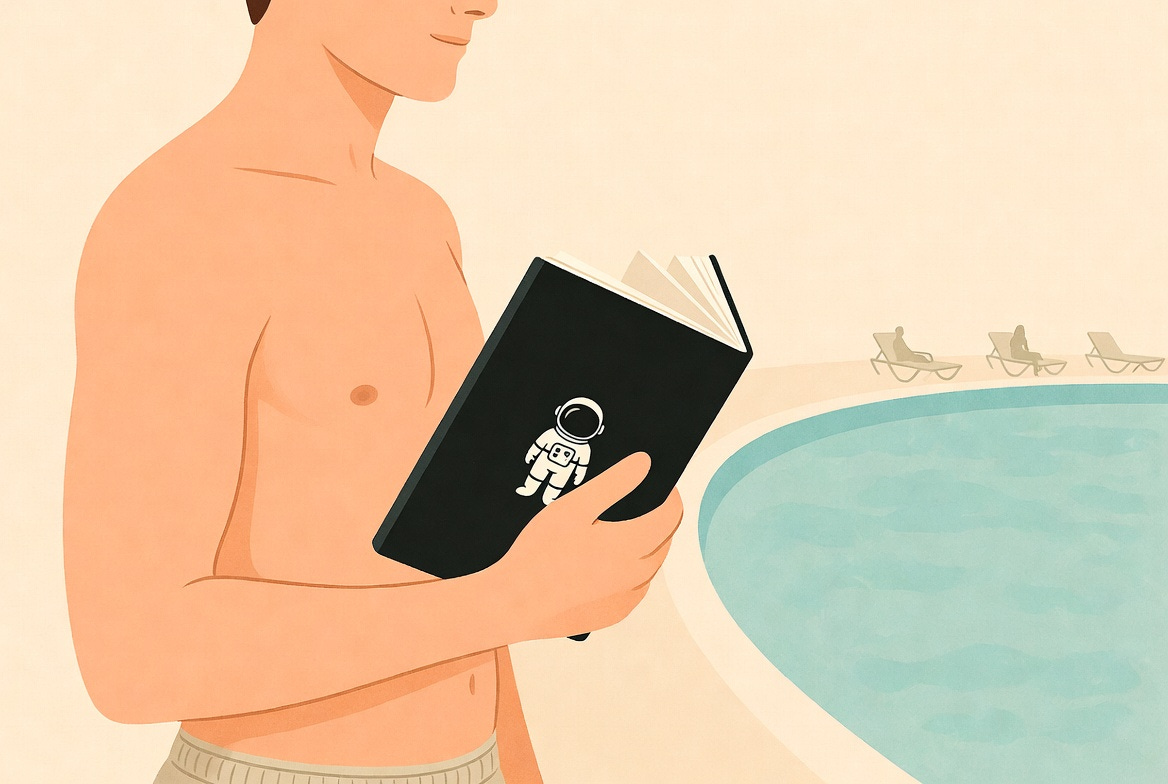
At my son’s birthday party, we held an event at the community pool. We invited some family, but it was mostly our neighbors. Unlike the day before, the day was cloudy, so it offered a retreat from the hot Florida days we were beginning to experience as spring melts into summer. In the midst of the chaos of a toddler birthday, as kids swam, jumped, and splashed in the pool, I noticed a man with a book.
This neighbor, who happened to be there, was new to me. I had never met him, but I did recognize his book: Hail Mary. Andy Weir’s book has been getting more attention this year since the film came out, which I hear is a masterpiece, but I have yet to see it. I did read the book, however, and thoroughly enjoyed it.
The man walked slowly and I stopped him.
“That’s a great book,” I said.
He hesitated as he watched his wife and children continue walking toward the exit of the amenity center. He turned to me, eager to start a conversation. “You read it?” he asked.
I told him I did and that it was a favorite read of mine.
“My boss told me it was good so I just figured I would read it too,” he shrugged, implying he wouldn’t normally read it. Then he began asking about science fiction in general, and how he’d been dabbling in that world. He mentioned what sounded like a more technical science fiction book, but I did not recognize the title.
“Try The Three-Body Problem,” I recommended. “If you like the science and math from Hail Mary and The Martian, you’ll like it too.”
His wife hinted that it was time to go, and we split ways. It wasn’t long after that I found other things in common with him and ran into him again, continuing the conversation over time.
That same day, I saw an older neighbor walking around with a biography of Teddy Roosevelt; it was the same one I had planned on reading the following week. As I watched him fade away, I wished he had left a little later so I could have sparked a conversation with him too, for the chance to meet someone new with a fresh story and a different perspective.
The pool as invitation
When someone brings a book to a public swimming spot, they’re already aiming to relax and learn something new. Ideally, their cortisol is low and they’re waiting for something exciting to come into their life: a new fact they didn’t know before, a story so intriguing they’ll think about it for weeks. Perhaps, too, as they walk around with a cover visible to all, deep down, they want to talk to someone about what they are reading.
The book is, at its most foundational level, a conversation between the reader and the author. If the reader enjoys the book, they might recommend it to friends; but unless they meet someone who has read it and is as passionate about it, the experience ends internally. There are few people they can talk to on an equal level.
In many ways, it’s like an orchid hybridizer who spends seven years raising a new cross from seed, finally sees it bloom, but has no one to share it with. They can enjoy it themselves, but they can’t reach the fullness of joy that comes from sharing it with someone who will also appreciate it.
The opposite is reading a book in solitude, which can feel limiting and blunted. When I read Stoner, it was one of the best literary novels I had read in years. But because I found out about it through viral posts on X and Substack, I knew no one else who had really read it. After connecting with others on Substack and Reddit, I was finally able to digest and explore the book with others, all while making new friendships.
Book clubs and online communities help with this, but it’s difficult to find one that’s reading the random book you just picked up, and the variety and surprises of making new connections only last for the first few times you attend.
The hesitation
What holds most of us back is a miscalculation. Nicholas Epley, a behavioral scientist at the University of Chicago, has spent years studying why people avoid talking to strangers in public — on trains, in waiting rooms, at the pool. His research found that people consistently expect silence to be more comfortable than conversation, but report the opposite once a conversation actually happens.
We overestimate the awkwardness and underestimate the other person’s willingness. The man with Hail Mary hesitated for half a second before turning toward me. That hesitation is universal. But the book gave both of us something to stand on before either of us had to say a word.
A shared book collapses the distance between strangers before the conversation begins. A visible cover is a pre-approved topic, a signal that says I am curious about this to anyone who recognizes it. Two people who have read the same book haven’t just consumed the same information; they’ve spent time inside the same imaginative space. That’s a different kind of common ground than shared weather or a mutual acquaintance. It’s closer to a shared dream.
Common ground
These experiences, the readers we run into at the pool, airport, cafes, and common places, are one of the few moments we can find common ground instantly, in settings made for conversation.
But meet someone at the pool who’s reading what you have, and you have an entirely new world to explore together. You can strike up a conversation and make a new friendship at the same time. This reader will often feel encouraged knowing someone else has read the book, has something good to say, and knows they can reconnect later to talk about the ending.
When the reader steps out with their book, they’re already making a commitment. They are no longer experiencing the story at home; they are bringing it out into the world, fully accepting the reality that comes with it: a splash of water from a glass, a pool, or a coffee; bent pages from placing it on the car door; a random conversation when someone recognizes the piece.
This brings opportunity. It is an invitation for a new relationship on common ground. Perhaps I’ll see the man with the Roosevelt biography I missed — and this time I’ll have read the book.
anything to encourage us to communicate more and experience new things is terrific, conversation is somewhat of a lost art