


My parents bought my son a wooden train set when he was three. We spent long afternoons on the living room floor, piecing together track, imagining where the passengers would go.
A year later, I bought a 3D printer. Suddenly, we could make our own trains and add to the track. It made the whole thing unique to us.
Playing with that train, I asked myself: why does a model — a small, imperfect representation of something much larger — produce so much imagination? Why does the miniature open the mind when the real thing, or reality, often closes it?
The funnel
You see a similar instinct in other disciplines. A graphic designer sketches before she builds. A writer outlines before she drafts. These early stages share something important: no costs have been sunk and no decisions are final. You are free to imagine without the weight of constraints.
The prototype bridges that open imagination to something pragmatic. Like a funnel, a vision begins wide and narrows as constraints arrive — budget, time, and technology. What starts off as large must be refined to precision.
The danger is starting the funnel too small. When we let reality in too early, it shapes what we allow ourselves to imagine. That may be practical when time is short, but it minimizes what could have been possible.
The priest with the impossible idea
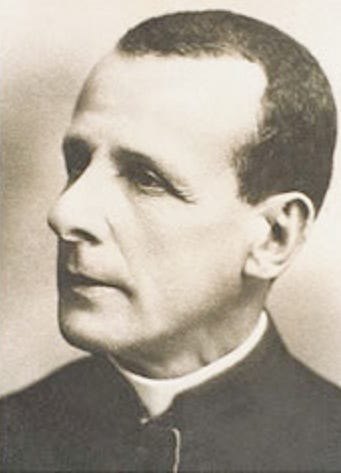
In the lavender haze of São Paulo, Roberto Landell de Moura stood on a hilltop with equipment he had built himself. A Catholic priest had no obvious business thinking about the impossible. He had grown up modestly in Porto Alegre, studied theology in Rome, and somewhere between the two had taught himself physics and chemistry. He dreamed of transporting the human voice through invisible waves.
On June 3, 1900, with journalists and the British Consul watching, he transmitted a human voice from Avenida Paulista to Santana hill; eight kilometers through open air, no wires; radio, born far from the science centers of the time, in a peripheral country, by a man working alone with limited resources.
Three years later, Guglielmo Marconi — already world-famous for his work in radio telegraphy — told a reporter that voice transmission would only be useful for short distances and that he didn’t believe in its improvement. Landell had already done it. It was only possible because he held the vision long enough to experiment his way toward it. While the expert had closed the funnel, the priest had kept it open.
What the model nurtures
That willingness — to take an idea seriously before it deserves to be — is what the modeling stage protects. At this point, you don’t listen to doubters, and you don’t listen to those who already have a solution. You listen to curiosity and instinct.
Technology has made this easier. You can sketch a website, a business plan, a 3D model in hours rather than weeks; more room to test what you’d only half-formed. But there’s a threshold that the generated thing can’t cross on its own. It isn’t until you hold the model — until the designer takes the idea and begins to tinker — that it comes alive. You see things you wouldn’t have noticed just looking at a screen.
W.B. Yeats wrote: “The world is full of magic things, patiently waiting for our senses to grow sharper.” That sharpening happens by touching, adjusting, and playing with ideas.
Unlearning
To reach that state, something first has to be unlearned.
Life accumulates constraints and inherited opinions, many of which are more abstract than they appear. Someone who has avoided the beach for years because of a bad sunburn could choose to encounter the sun again without that history — to notice how it feels at different hours, in the water and out, what exposure feels good and when it becomes too much. Through that curiosity, they might find not just more time at the beach, but questions they hadn’t thought to ask.
This kind of unlearning usually arrives with a question: what if? The child who asks why and what if — without embarrassment, without the weight of what’s already been tried — discovers things the experienced adult has stopped looking for.
What if I could fly
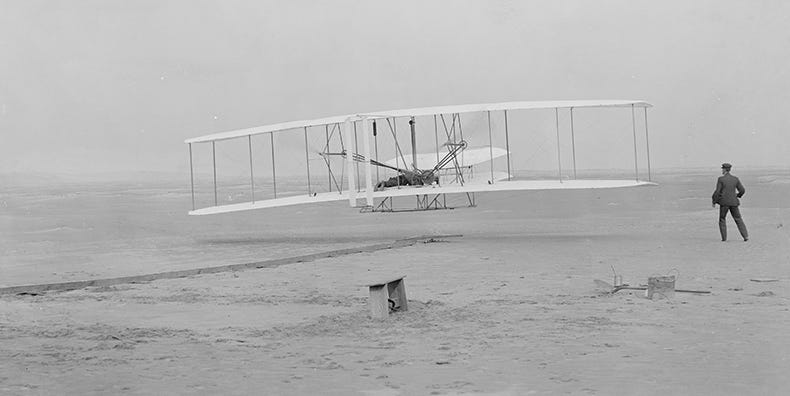
What if I could fly? A fantasy, and then a daily fact visible in every sky. It took many people across many decades to make it real. Franz Reichelt died jumping from the Eiffel Tower in 1912, testing a parachute suit he’d built. Others died in fields. The question moved toward the hot air balloon and eventually to Dayton, Ohio.
David McCullough quotes Orville Wright in his biography of the brothers: the greatest advantage they had, Orville said, was growing up in a family where intellectual curiosity was always encouraged.
Their curiosity wasn’t untethered, though. The Wrights studied bird flight methodically, used what they learned, failed, and adjusted. The model — the physical glider, the wind tunnel — gave their imagination something to push against. And eventually it flew.
Back on the floor
In my own work, I remind myself of this balance often. An idea stays an idea until I write the first draft and have something to shape. The outline, the sketch, and the model: that’s where unlimited possibility meets the hand.
When my son and I sit on the floor with that train set, adding pieces we printed ourselves, I think that’s what we’re really doing — chasing curiosity, keeping the world open a little longer before the constraints arrive. Then building something worth the awe.
hope I’m removing some of those mental constraints for my students all the time